
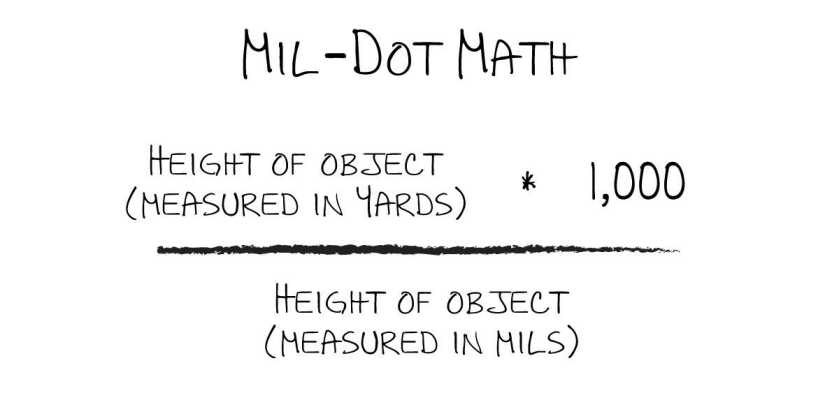
The mil dot formula is simple: range in yards equals the target’s size in yards times 1,000, divided by its size in mils. A mil, or milliradian, is an angle that covers 3.6 inches at 100 yards, 1 yard at 1,000 yards and 10 centimeters at 100 meters. Because a mil-dot or MRAD reticle is marked in the same angle as the scope’s turrets, you can use the same numbers to range a target, hold over for drop, hold for wind and dial corrections. Learn three versions of the mil relation formula below and you can work almost any problem in your head. If you think in inches and MOA instead, see our companion guide, minute of angle explained.
Table of contents
Mil Dot and MRAD at a Glance
- 1 mil equals 3.6 inches at 100 yards, 36 inches (1 yard) at 1,000 yards, and 10 centimeters at 100 meters.
- 1 MOA equals 1.047 inches at 100 yards, so 1 mil is about 3.44 MOA.
- Most mil scopes adjust in 0.1 mil clicks, about 0.36 inch at 100 yards.
- Ranging formula: range in yards = target size in yards x 1,000 / mils.
- Correction formula: mils = drop or miss in yards x 1,000 / range in yards.
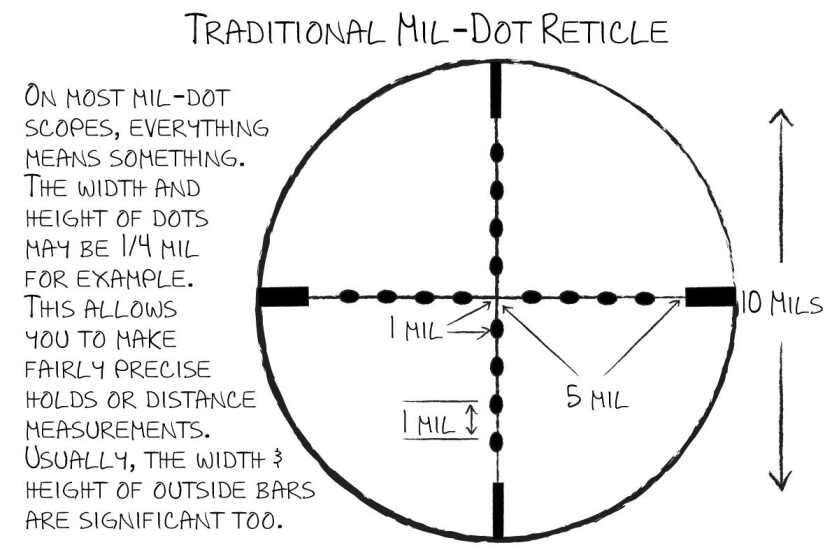
- A traditional mil-dot reticle spaces its dots 1 mil apart, center to center.
- First focal plane reticles range at any magnification. Second focal plane reticles range correctly only at their calibrated magnification.
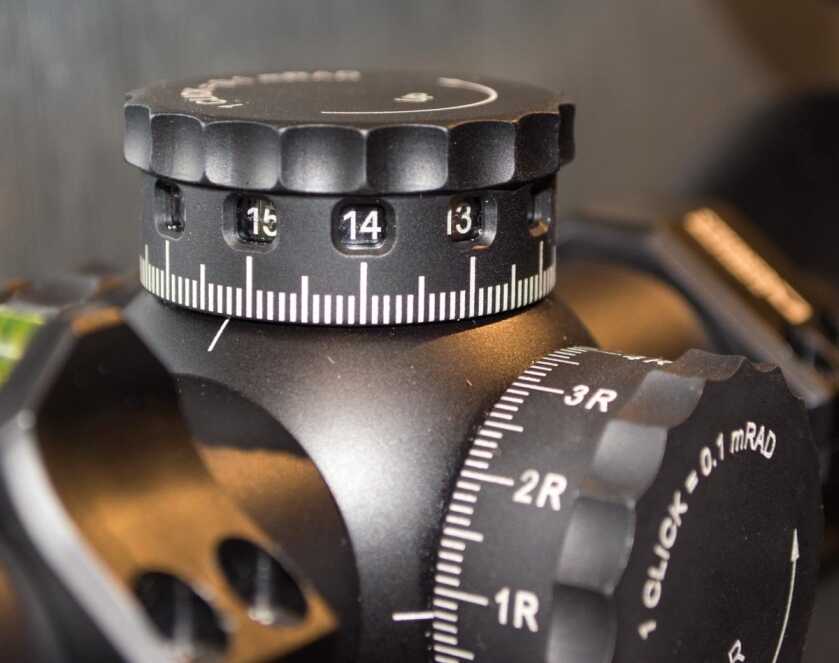
What Is a Milliradian?
A radian is an angle. Walk around the edge of any circle a distance equal to its radius, and the angle you covered is one radian. A full circle is 2 times pi, or about 6.283 radians. A milliradian is one thousandth of a radian, so a true circle has about 6,283 milliradians.
You may also hear that a circle has 6,400 mils. That is the NATO artillery convention, rounded to make compass and map math easier. The Warsaw Pact used 6,000, and other armies have used other numbers. Rifle scopes and mil-dot reticles use true milliradians, which is why 1 mil equals exactly 1 unit at 1,000 units of range. Stick with the true mil and the math below always works.
In practical terms, if you could hold your hands apart at an angle of exactly one milliradian and look between them, you would see 3.6 inches of a target at 100 yards, 7.2 inches at 200 yards and 36 inches at 1,000 yards. Angles scale with distance, which is what makes mils so useful.
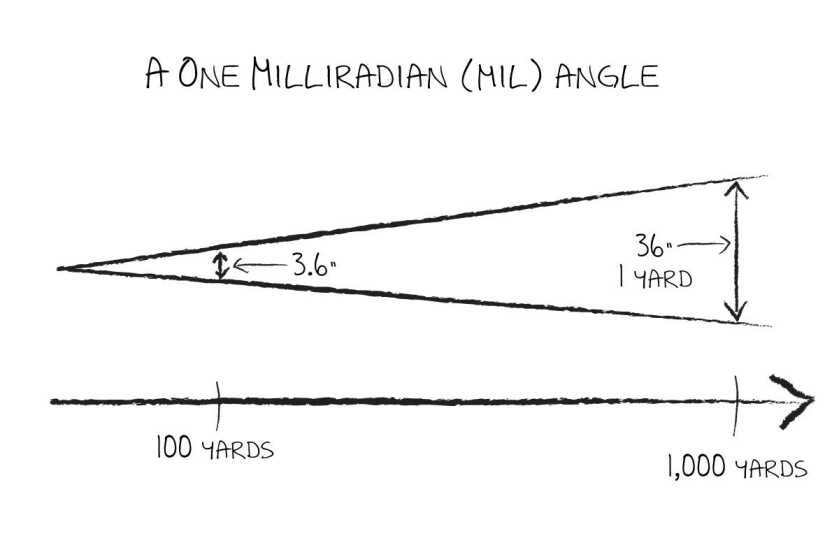
Why Scopes Use Angles Instead of Inches
A bullet starts falling the moment it leaves the barrel. The scope sits above the bore and is angled slightly down toward it, which is why a bullet appears to rise and then fall across its path. To hit a distant target, you have to aim higher, and the farther the target, the more you hold.
You could figure that in inches, but inches do not scale. A 10 inch correction at 300 yards is not the same as 10 inches at 600 yards. An angle does scale. A 1 mil correction moves impact 3.6 inches at 100 yards, 10.8 inches at 300 yards and 21.6 inches at 600 yards. That is why turrets and reticles are marked in mils or MOA rather than inches.
The Mil Relation Formula
All the useful mil math comes from one relationship between size, range and angle. Use yards for both size and range, and 1,000 as the constant.
Formula 1: Find the Range
Range in yards = target size in yards x 1,000 / size in mils.
Example: a deer’s back to brisket is about 18 inches, or 0.5 yard. If it measures 1 mil in your reticle, the range is 0.5 x 1,000 / 1 = 500 yards. If it measures 2 mils, the range is 250 yards.
If you prefer inches, multiply the target size in inches by 27.78, then divide by mils. An 18 inch target at 1 mil gives 18 x 27.78 / 1, or about 500 yards.
Formula 2: Find the Correction in Mils
Mils = drop or miss in yards x 1,000 / range in yards.
Example: your ballistic data says the bullet drops 36 inches, or 1 yard, at 428 yards. That is 1 x 1,000 / 428 = 2.34 mils. With a 0.1 mil turret, dial 23 clicks up, or hold 2.3 mils high in the reticle.
Formula 3: Find the Size
Size in yards = range in yards x mils / 1,000.
Example: a target 400 yards away measures 1.5 mils. It is 400 x 1.5 / 1,000 = 0.6 yard, or about 21.6 inches.
How to Use a Mil-Dot Reticle
A traditional mil-dot reticle has dots along the crosshairs, spaced 1 mil apart center to center. Modern MRAD reticles use hash marks or Christmas tree grids at 0.5 or 0.2 mil spacing, but the math is the same.
- Holdover: if your data says 3 mils of elevation at a given range, put the target on the third dot below center.
- Wind: if you need 0.5 mil of wind, hold halfway between the center and the first dot into the wind.
- Ranging: bracket a target of known size between the crosshair and the dots, read its size in mils and use formula 1.
- Spotting misses: if a shot lands 0.4 mil low and 0.2 mil right, dial 4 clicks up and 2 clicks left on a 0.1 mil turret.
First Focal Plane vs Second Focal Plane
On a first focal plane scope, the reticle grows and shrinks with magnification, so a mil is a mil at every power. On a second focal plane scope, the reticle stays the same size while the target changes, so the mil spacing is only correct at the magnification the maker calibrated it for, often the highest power. Check your manual before you range with a second focal plane scope.
Zeroing With Mils and MOA
Mils also make zeroing easy, as long as the reticle and turrets use the same unit.
Example: you fire a group at 100 yards and it lands 3 inches high. In mils, 3 inches at 100 yards is 3 / 3.6 = 0.83 mil, so dial about 8 clicks down on a 0.1 mil turret. In MOA, 3 inches at 100 yards is about 2.9 MOA, so dial about 11 to 12 clicks down on a quarter MOA turret.
The same goes for longer range corrections. A 36 inch drop at 428 yards is 2.34 mils. In true MOA, it is 36 / (4.28 x 1.047), or about 8.0 MOA, about 32 clicks on a quarter MOA turret. The popular shortcut of inches divided by hundreds of yards gives 8.4 MOA, which is close but drifts farther off as range increases.
Mil vs MOA: Which Should You Use?
Both work. The best system is the one where your reticle and turrets match, so you never have to convert in the field. Mil scopes dominate precision rifle competition and are popular with shooters who work in meters or with spotters calling corrections in mils. MOA is common on hunting scopes and is easier for shooters who think in inches at 100 yards. For the MOA side of the story, read minute of angle explained.
If you are shopping for a scope with a mil reticle, our reviews of the Sightron SVIII FFP 5-40×56, the Arken EP-5 Gen II, the Leupold VX-3i LRP and the Riton X3 Conquer 6-24×50 are a good place to start, along with our guides to the best rifle scopes under $1,000 in 2025 and the best LPVO scopes.
Mil Dot FAQ
What is the mil relation formula?
Size divided by range, times 1,000, equals mils, as long as size and range use the same units. Rearrange it to find range (size x 1,000 / mils) or size (range x mils / 1,000).
How many inches is 1 mil at 100 yards?
3.6 inches. At 1,000 yards, 1 mil is 36 inches, or 1 yard.
Is it 6,283 or 6,400 mils in a circle?
A true circle has about 6,283 milliradians, and that is what rifle scopes use. 6,400 is the NATO military convention for artillery and compasses.
How many MOA are in a mil?
About 3.44 MOA per mil.
Can I range with a second focal plane scope?
Yes, but only at the magnification the reticle is calibrated for, usually the highest power. At other magnifications, the reticle’s mil spacing is wrong.
What is a 0.1 mil click at 100 yards?
About 0.36 inch, or about 1 centimeter at 100 meters.

Literary assault dude writing guns & shooting books and articles. Personal accountability rocks!
Can’t/won’t do the math. I know what my round does, know clicks per inch, adjust for range. As a Marine shooter, I can read wind & use hold. Works fine to put 5 in the head at 1k.
Can’t/won’t do the math. I know what my round does, know clicks per inch, adjust for range. As a Marine shooter, I can read wind & use hold. Works fine to put 5 in the head at 1k.
Easier way to zero at 100 yd.
1. Pull your bolt and find the target looking through the barrel.
2. Move your crosshairs to the target while holding your barrel on the target.
3. Fire a round. It should be close.
4. Put your crosshairs on the target and then move them to the point of impact.
5. Put your crosshairs back on the target and fire a round. That will give you a 2 shot zero.
EXCELLENT!
Finally a professional looking rear sight but how about a flush-mounted magazine?
In all honesty – damn near every ‘ranch/truck’ gun pull-out for me has been 3 or less rounds.
At 83 I still shoot, & I use open sights. As a young man I was
taught marksmanship by the
Marine Corps. Elevation to hit
the target “simple” combat sights
are 10 clicks (200 yds), my 500
yard sights was 22 clicks. The
weapon used was an M1-30-06
if you can shoot and understand the principal of ballistic one does
not need a scope unless you do long range shooting (1,000 yds )
(2 Pi R) Just so the kids who are forced to learn Arithmetic Sequence Formulas don’t pick up our boomer ways…..LOL!
Thanks for the great article. I mostly shoot pistols but the last year I have gotten interested in rifle shooting. Your article helped soooooo much.
Thank you and I look forward to your next one!
From a newbie rifle guy.
C’mon guys just do what Chris does. Sight in at each range and make a note
of how many clicks you used or the numbers on the turret. Tape it to your
stock if you don’t want to loose it. No math needed.
Zeke
Why use mil calculations in inches and yards?
For me ; mils in metric and .1mil turrets
Moa in standard
Target size in mm devided by mils equals range in meters!
Or do what I do here in Northeast Ohio Never shoot at anything more than 10 yards away.. Actually, its almost impossible…
I meant “100” yards away.. Several of my computer keys get stuck a lot.. Then again, when I archery hunt, most of my shots are around 10 yards…
Excellent article! Had no problem following it. Look forward to reading your next article on range estimation.
Why bother fussing with mildots at all just get yourself a Revic PMR428 scope and get accurate data each time you\’re ready to pull the trigger.
1 MOA = 1.0472″ at 100 yds
1 mil = 3.6″ at 100 yds
1 mil = 3.4377 MOA (at any distance, both are angular measurements)
3.5 mils = 12.03 MOA ; let’s round it up to 12 MOA = 48 clicks
1 click = 1/4 MOA (depends on the scope)
Mils = (1 yard * 1,000) / 428 yards = 2.3 mils.
So, using our earlier example, if we have to aim 36 inches high to hit a target at 428 yards downrange, then the equation works like this:
MOA = 36 / 4.28 hundreds of yards = 8.41 MOA.
Since MOA’s are “smaller” you need more of them than mils to make the same amount of adjustment. If your scope adjusts in ¼ MOA clicks, then you will raise your desired point of impact 8.41 MOA / .25 MOA per click, or 34 clicks. It’s actually 33.6 clicks, but you can’t do .6 of a click!
Let’s round up the range to 700 yards for simplicity. Consulting the chart above for a 200 yard zero, Federal OTM .308 Match at 700 yards has a drop of 158.8 inches.
Formula for calculating MOA adjustment is as follows:
Adjustment in Inches / (Range in Yards / 100) = MOA
So plugging in the numbers above:
158.8 / 7.00 = 22.68 MOA
To calculate number of clicks, the formula is:
Clicks of Adjustment = MOA / MOA Fraction
So for 23.17 MOA of adjustment with a 1/4 MOA scope, the numbers are:
22.68 / 0.25 = 90.74 clicks or 91 clicks.
Hope your scope has a lot of adjustment range! Many scopes do not at at these ranges, many equip a rifle with a canted 20 MOA or 30 MOA scope mount to provide extra elevation. A 20 to 30 MOA rail on a 1000 yard competition rifle is a must.
As you can see from the formula for clicks, a finer adjustment on a scope increases the number of clicks. For a 1/8 MOA scope, it’s 182 clicks instead of 91. For a 1/2 MOA scope, the adjustment is 45-46 clicks. The finer adjustment allows more precise accuracy. It also helps if you do have the exact drop for a given range. Ballistics software helps with this if you know the muzzle velocity and ballistics information for your bullet, it can calculate the exact drop for a precise range. That makes your adjustments much more accurate.
I have a question that to me would be simply answered. I have one rifle with Mil-Dots. I have it zeroed at 100 yds. Now if I wanted to shoot at 100 yds then I’m dead on. What I need to know is why I couldn’t use the first dot down for a specific distance, say 200 yds. And the third one for 300 yds. ect. I am shooting a .223, Hornady 55 gr ballistic tip. I need to know is there a way to simplify this process without a bunch of match. If someone can give me a clue on this please let me know. Thanks
I know this is a bit of an old question but, yes, that is possible but you have to first determine at what distance your rifle drops by exactly 1 mil, 2 mils, etc. That would then be the distance for each mil dot. Don’t confuse mildot scopes with BDC scopes. In a bullet drop compensated (BDC) reticle each dot is designed to be a distinct distance (200, 300, 400 yds, etc.) but the scope is designed for average in a specific caliber. A BDC will only be semi-accurate for the stated caliber.
The BDC is easier for average shooting but the mildot gives you a lot more flexibility if you do a little homework with a ballistics calculator.
Did I miss where you said that these calculations only work at one magnification? Not an issue in a fixed 10x scope but on a 4-16x or other variable power scope with a second focal plane reticle the dots are only accurate at one magnification. I put a 10 cm ruler at 10m then adjust magnification until the mil sub tends the ruler then use a paint marker to identify that power setting.
This reply is a bit late, sorry. What you are talking about depends on the scope reticle system. For a second focal plane reticle system (the reticle stays the same size no matter the power setting) you are correct, the measurements are only correct at one power. The owners manual should tell you which power.
For first focal plane systems the measurements are correct at all power settings, as the reticle is magnified along with the target.
Thank you for this clear, logical and succinct explanation of some complex math principles. If my high school math teacher had been so gifted, I just might have stayed in trigonometry! So many would rather prove they are smarter than you instead of helping you understand.
LOL. I really enjoyed this story; it highlights two things about Math and the Internet. One, you first have to understand something to explain it and two, it never goes away.
Good article and explanations. But I need more help.
I’m trying to explain a quote in a letter from my late father (1920-2013) talking about artillery training at Fort Sill in 1943. He wrote: “. . . but A and C fluffed their first shoots badly and spread 100 mil errors all over the range. Errors are one thing the school cannot abide, and I cannot say I blame them.”
What is the significance of 100 mil? Does this mean they *really* made a hash of things? Thanks for any help.
S
Hello Sarah – I’m writing you from the future in 2024. I woke up today wondering about radians and how they work. I felt called to try and respond to your question because I grew up in OK near Ft. Sill. There are two ways to look at your father’s comment. One way is 100 milliradian = 0.1 radian. If your father was 1 mile away (the radius of the circle), the company missed by 0.1 miles ( 0.1 * the distance from the target). Alternatively you can change radians to degrees of an angle by multiplying radians by 180 and divide my Pi. Thus, 100 milliradians is 0.1 radians. 0.1 radian * 180 / 3.14 = an angle error of ~5.73 degrees.
A click = 1 cm at 100 meters …. 1 mil = 10 cm at 100 meters … no MOA, no YARD Sorry, it’s metric system the mil-dot is the same, why merge with inches and yards??????
why is it that when people talk about MOA and practical application it is shoot at 100 yrds then see how many inches it is off from center, 3 inches them click 3 MOA what about MRAD which is what the article was about?
Guess I’m a bit late to the party. I have to say, my understanding of mils and moa is no better now than before I read the article. On a positive note, my head hurts worse. Not once have I actually had time to whip out pencil and paper or a calculator while in a tree stand or blind. Kentucky windage has always worked well for me. I don’t miss often.
Great article about : “MILDOT Made Easy”. Very well written and straight to the point. However I do have a question others have asked me but I didn’t know how to respond. Maybe you could shead light on the subject. If I’m ranging a target say a white tail deer (30″ chest to back) but I want to increase the chances of hitting within a six inch vital zone, would using 6″ to calculate range and calculate come ups cause a miss? I use 30″ then come up and hold dead one knowing my bullet may strike anywhere in that 30″ tall area. What do you say?
I might be misunderstanding the question, but when I hear “ranging” that means determining the exact distance to target by looking at how big an object of known size is compared to the scope reticle markings. For example, if that 30″ chest to back covers 9 minutes of angle hashmarks in your scope view, then it must be 318 yards away (30 inches / 9 MOA) * 95.5. Knowing the exact distance allows you to aim exactly where you want if you know your bullet type and its velocity. Tons of smartphone apps, cards, etc can tell you the exact holdover or scope turret adjustments if you know the exact range to target. See https://www.gunsamerica.com/blog/optics-buying-guide-finding-range-scope/ for more info on the whole ranging thing.
this is the worse explanation ever, as the author made it harder to understand the concept by using the Inch instead of centimeter… the MRAD is better (higher granularity) and easier (no fraction) when compared to MOA.
1 MRAD corresponds to 10 cm exactly (centimeter) at 100 meter … exactly with no fraction
vs
1 MOA corresponds to 1.047 inch at 100 yard
that’s all !!!
Base MRAD, US MRAD or Russian MRAD? They are all different…only one of them is accurate to your description.
Last I checked, this isn’t Russia.
Thanks, this was a great article.
Must be an American who writes a whole article about MILs without using the meter … the point is, that 1 mil is 1 cm in 100 m or 2 cm in 200 m. 2 mils is 2 cm in 100 m. And that you can calculate. So, please folks behind the pool, forget about your ridcolous inches and furlongs and yards and lines and chains and pegs and poles and miles and all of that medevial fairytale crap.
100% agree. Although it’s basically taboo to say that here… The American system makes zero sense, but who am I to talk?
Here, in Americia, it makes perfect sense. Sorry it hurt your Metric heads 😉
No it’s not. It is 10 cm at 100 m or 1m at 1000. Think twice Mr. Metric.
Another way to look at it (since the mil is SI equivalent to “millimeter per meter”), is that 1 mil equals:
1 mm at 1 m, or
10 mm at 10 m, or
100 mm at 100 m,
1000 mm at 1000 m, etc.
For instance
50 mm at 500 m would be: 50/500 = 0.1 mil.
3 mm at 100 m would be: 3/100 = 0.03 mil
Those inches, furlongs, and yards made believers out of the Nazis, Imperial Japanese, and Italian Fascists in WWII…They launched the unmatched P51 Mustang as well as the P47 Thunderbolt, and the British Marine Spitfire, and still to this day NATO shoots a .308″ diameter bullet (ya ya..nicknamed the 7.62), and launched the most powerful nation on the planet, but the old English measurement system has proven itself over and over again to be as good or better than any of that metric “crap”.
The “What’s next example” would have been better, had you given the example of being at the range sighting-in your rifle using milliradians. Especially for those of us who are using a scopes with turrets in milliradians. Your explanation of milliradians was great and easy to understand however I was thrown for a loop when you gave the example of being at the range and using MOA. I thought we were talking milliradians. So to come up 0.9 mils for a 3.24 inch elevation at 100 yrds. I guess?
I only used the MOA example because the majority of affordable scopes out there with mil-dot reticles still use 1/4 MOA click adjustments on the dials. Why? Got me… Like you I think, if my reticle is in milliradians, I want the dials set that way too 🙂
A click = 1 cm in 100 meters …. 1 mil = 10 cm in 100 meters … no MOA, no YARD Sorry,
1/2 the diameter x 2 x Pi = perineter ( asshat that =D divided by 2 x 2 x Pi = perimeter or briefly Pi x D = perimeter
The article stated :
“Half the diameter of a circle, times two, times Pi, equals the distance all the way around”.
But in actuality; Half the diameter of a circle, (squared), times Pi, equals the distance all the way around.
Pi times radius squared is the area of that circle. Two Pi times the diameter is the circumference.
Almost. The product of Pi and the diameter is the circumference (or 2πr).
The army uses 6400 mils to the circle because for artillery and mortars because it is divisible evenly into 4 1600 mil quadrants. Using 6280 mils would introduce too many opportunities for error in computation of firing data. The difference between 6400 and 6280 mils for quadrant (range) and deflection (direction), 120 mils, would introduce a constant error of 10 feet per thousand yards or 3 meters per kilometer which is programmed into the manual firing tables or fire control computers. When you have a casualty producing radius of 50 meters with the 105mm High Explosive round and 100 meters with the 155mm High explosive round this error is negligible. I was an artilleryman in the Army so I can’t give an informed estimate for the 60 and 81mm mortars of the infantry.
Thank you for sharing the details on the Army numbers! Interesting stuff and that makes a lot of sense. Now if we could only figure out the Russians’ logic…
Excuse the math error that should read 100 feet at 1000 yards or 30 meters per kilometer. That’s why there’s tabular/graphic firing tables and fire control computers. Sunday PM brain fart.
If I remember correctly, the killing radius of an 81mm mortar was 20 meters; and, the killing radius of a 4.2in mortar was 35 meters. With VT (variable time) fuses, you get a nice air burst, about 20 feet over the target, that increases the effectiveness. I’m a former Army infantry forward observer. We used the “WORM” formula (Width of adjustment in meters equals Range in meters, divided by 1000, times mils to the target) to compute lateral corrections to bring a burst onto the target. It’s a lot easier to work out in your head using 6400 mils than it would be using 6280!
Surprised the 4.2 didn’t have a larger killing radius. Interesting ’cause 4.2 is nominally equivalent to the 105mm. Different projectile weights? The 105 HE projectile weighed apprx. 35 pounds.
I know that I’m very late with this reply; but, the 4.2″ mortar round also weighed 35 pounds.
Yup its the exact same for 60’s and 81’s
Sunday PM brain fart: the comment should read 100 feet per thousand yards–a 10 percent error or 33 meters per kilometer.
6400 is great to work with math-wise. 45 degrees = 800mils in the US system whereas it’s 750 in the Russian system. Every octant around the circle is 800 mils. Subcardinal directions (NW, SE) always resolve to an easy number.
US wins on this one.
A click = 1 cm in 100 meters …. 1 mil = 10 cm in 100 meters … no MOA, no YARD Sorry,
Trying to discuss mils and using the Imperial system as your reference is just wrong. Mils were designed to be used with the metric system. 1 mil of angular deviation is roughly 1 meter on the ground at a distance on the ground. I say roughly because it’s actually not, due to the error of saying there are 6400 mils in a circle when there really are 6280, and we introduce a constant error, that we in the artillery community call the “smart guy factor” of 1.0186 (6400/6280 =~1.0186). This factor works when you’re converting meters into mils, but not in reverse. To convert mils to meters you need to use 0.98125 (6280/6400). Using inches and mils together causes computational errors and will not give you an accurate ballistic solution without needless additional math steps.
-Captain Paul Willard, USMC, Gunnery Instructor, US Field Artillery School
1 mil of angular deviation is roughly 1 meter on the ground at a distance of 1000 meters away from you.
After 7 years in Field Artillery I could never figure out what the “smart guy factor” is I just new it was important. A few of the good answers I have found to artillery related questions have actually come from the USMC Artillery school. Thanks for the knowledge sir.
Heres a question: you have a scope that measures in m.o.a. & it has a ballistic reticle in the second focal plane calibrated for 8x. If you turn the power up to double, or 16x (to see the target better), does it effectively half the measured distances of the ballistic reticle subtensions?
an easy way to sight in is to get a large target backer place a mark or a bull’s eye on the target aim at said bullseye fire a shot notice the point of impact. place your crosshairs back onto the bullseye make adjustments with your scope to bring the crosshairs into or on your point of impact from previos shot this allows you to adjust the scope without having to measure anything fire another shot at the bullseye and repeat the process until you’re dialed in properly I can dial in a scope within 3 to 5 shots very easily using this method
Thanks for the information on Russian mils. Now I know why a PRC made knock off of a GI compass was marked 6,000 mils to a circle.
The U S Arm (and NATO standard) uses two miles: The Artillery mil is 6,400 to a complete circle, çlose enough for government work’.’ The Engineer mil comes 6,280 to a ccomplere circle which is closer to the actual vale of 2 pi times 1,000, or 6,283.
Minutes of angle at 100 yards is pi/3 inches, o about 1.047 inches, better round to 1.05 inches in lieu of 1.04 inches. And a 1/4 m.o.a. click at 100 yards is about 0.26+ inches.
A 1/10 (0 0.10) mil click is 0.36 inches (exactly) at 100 yards.
Most ‘scopes these days have the reticule in the second focal plane. For these second plane ‘scopes, the difference between mil-dots varies with the magnification. Typically, on such ‘scopes, the reticule is set up so that at one specified magnification, the distance between dots is correct…typically about 10 X.
To have a mil-dot ‘scope with clicks in some fraction of m.o.a. or in fractions of an inch is absurd and makes things much more complicated than necessary.
I’ll never willingly go back to a second focal plane reticule or to either fractional m.o.a. or in c.o.a. makes no sense; the math to convert the one to the other is cumbersome. I have used a relatively inexpensive first focal plane (reticule) scope with mil-dot reticule and clicks in 1/10 mil. and I’ll never want any other arrangement than first focal plane mil-dot reticule with adjustments in clicks of 1/10 mil(or 0.10 mil.) That ‘scope is the BSA scope made for MidwayUSA. I keep plaguing both Larry Potterfield at MidwayUSA as well as B S A to get a similar ‘scope with higher magnification–the preesnt one is about 4 to 14 X and one in 6 to 20X or even better, 6 to 24X would be really great.
Trying to convert Mils and MOA is like the frustration we all have with trying to convert from our system of measurements (inches, fett, yards, etc.) to metric. I had an old Canadian soldier that I was working with tell me to stop trying to convert and to just think in the system you want to use. For example think in Mils. Don’t think in (for example) duhhh, my Mils equal 36 in at 1000yds and my MOA is 10 inches so I need to figure correction in inches divided by hundreds of inches or whatever. Buy a scope in whichever system you like and stick with it. Think in that system, live in that system and shoot in that system. If for some reason you are forced to switch to the alternate system, do like Chris said above and write your benchmarks on a card and tape it to the side of your rifle.
Me, I just use the Horus reticle and live, sleep, breathe that system.
My god boys it’s not that dam difficult. I use MOA I sight my rifles at 200yd zero, then I write on the stock of said rifle 200yd =0. 300yd = 7.8 and so on out to 1000yd the 7.8. (Is an example ) relates to the numbers and lines on your turret. So I would turn the turret until the number 7 is in line with the mark or line on the scope that 0 was in line with. Keep in mind the adjustment is in MOA so 7 is 7 minutes of angle .8 is 8 more clicks that are 1/4 MOA at 100yds.
How do I come up with that amount of adjustment. .A range finder a target and ammo. No chart no BDC. And I’ve dropped elk at 500 bear at 450 deer at 650 all with a savage 110 300 win mag and a Mark 4 LR/T 3.5 10 M1 turrets in MOA don’t over think it. Range it dial your scope pull the trigger
It works!!!!
Zoned out right after the promise of “no math” and then….it’s, wait for it, all math. There is much better instruction on this. Sorry.
Well I hate math, so I never have wanted to be a long range shooter. It could be fun though without the math. After reading this article I have decided if I want to make a long range shot I will just eat a pizza instead. Just give me an AK-47, a Glock 34, plenty of ammo and stand aside. Relax and everything will be good!
I’M TOTALLY CONFUSED. THERE WAS ENOUGH MATH IN THIS EXPLANATION TO MAKE ME THROW UP MY HANDS IN DEFEAT. I GUESS I’LL NEVER GET THE HANG OF THIS TYPE OF SCOPE. STILL MAKES NO SENSE TO ME.
Could you explain why you would use the 2nd dot below the cross hairs for a 3 mil correction?
Thank you. cblaz
Sorry Chuck, that’s a total typo! You are exactly correct in spotting the anomaly here, it should be the center of the third dot below the reticle for a 3 mil correction. I will fix that now and thanks for the heads up!
Seemed like a bit of a jump at translating mil dot to MOA. Aside from very basic math, please assume no knowledge on the part of your reader. We need caring tutorials and not the chat between peers that one so often finds in writers. One needs to understand the problems of the student, and then address that. It’s an empathy thing. Those who don’t have it are the most frustrating of teachers. JWC
Great article. Clear and concise. You must have a sub MOA rifle, consistant ammo and marksman skill while using mil-dot scopes or you will be chasing your tail. As you add distance you must add a correct caliber for terminal effectiveness. Precision work requires you to eliminate or accurately compensate for the variables. In real world application, you must be able to accurately measure the size if the target or something in the very close proximity. Is it a big man far away or a small man close? Is it a 55 gal. drum or a 30? 14 Or 17 inch vehicle rim? What do you “range” on in the bush where there are no man made clues? If you are willing to put in the time, then you will get much more then tacti-cool from a mil-dot and not need batteries. If you just want to hit a 3 foot plate at 600 meters save your money and just buy a bit more ammo.
Same typo in this formula MOA = 36 / 4.38 hundreds of yards = 8.41 MOA. True answer 8.21MOA
In the example the yardage was 428. So the forumla would really be…
MOA = 36 / 4.28 hundreds of yards = 8.41 MOA
😉
Dang those 2 and 3 keys! They really shouldn’t be right next to each other 🙂 Will fix…
Excuse the math error that should read 100 feet at 1000 yards or 30 meters per kilometer. That’s why there’s tabular/graphic firing tables and fire control computers. Sunday PM brain fart.