
5.7×28 ballistics depend heavily on barrel length. Factory 40 grain loads are rated at about 1,800 fps from a 5 inch pistol barrel, our chronograph showed slightly above 2,000 fps from a 9.6 inch KelTec KP50, and about 2,100 fps, roughly 390 ft-lbs, from a 16 inch Ruger LC Carbine. In our clear gel testing, 5.7 defensive loads fired from pistols penetrated 12 to 14 inches. That makes the 5.7×28 a flat-shooting, low-recoil, high-capacity cartridge that clearly outperforms .22 WMR and .380 ACP on paper, but it is not a rifle round, even from a carbine. This guide sticks to what we and the ammo makers have actually measured. For gun picks, see our best 5.7×28 pistols guide.
Table of contents
5.7×28 Ballistics at a Glance
- Typical bullet: 40 grain, with other weights available.
- 5 inch pistol barrel: Speer rates its 40 grain Gold Dot at 1,800 fps and 288 ft-lbs at the muzzle, and Hornady rates its 40 grain Critical Defense at 1,810 fps and 291 ft-lbs. These are maker ratings.
- 9.6 inch barrel, KelTec KP50: standard supersonic ammo chronographed slightly above 2,000 fps in our testing. Reduced-velocity suppressor ammo chronographed about 1,250 fps.
- 16 inch barrel, Ruger LC Carbine: about 2,100 fps and roughly 390 ft-lbs in our testing.
- Penetration: 12 to 14 inches in bare clear gel from pistols with Hornady Critical Defense in our testing. Expansion was not measured.
- Pressure: SAAMI maximum average pressure of 48,500 psi, versus 35,000 psi for 9mm.
- Recoil: very light, with high magazine capacity, often 20 rounds in pistols and 40 or 50 in larger formats.
Where the 5.7×28 Came From
FN Herstal developed the 5.7x28mm in the late 1980s for its P90 personal defense weapon and later the Five-seveN pistol. The goal was a small, fast, light-recoiling round with more reach than pistol cartridges. For years, FN guns were nearly the only option. That changed as Ruger, KelTec, PSA, CMMG, SDS and others brought out pistols, carbines and uppers. NATO standardization of the cartridge was announced in 2021, as we covered in FN 5.7x28mm getting NATO specification.
Velocity vs Barrel Length: What We Measured
Barrel length is the biggest factor in 5.7×28 performance. Here is what our testing and maker ratings show for 40 grain class ammunition.
- 5 inch pistol: about 1,800 fps by maker rating. Speer rates its load at 1,651 fps and 242 ft-lbs at 25 yards.
- 9.6 inch large-format pistol: slightly above 2,000 fps in our KelTec KP50 review.
- 16 inch carbine: about 2,100 fps and roughly 390 ft-lbs from the Ruger LC Carbine on a Caldwell VelociRadar at our 5.7 Fest.
- Suppressor ammo: about 1,250 fps from the KP50, which ran it without problems and was noticeably quieter.
The pattern is clear. Going from a 5 inch to a roughly 10 inch barrel adds a few hundred feet per second. Going from 10 to 16 inches adds less, about another 100 fps in our measurements. The carbine gains real energy and a flatter trajectory, but it does not turn the 5.7 into a .223.
Penetration: What Our Gel Testing Showed
At our 5.7 Fest, defensive 5.7 loads fired from pistols averaged 12 to 14 inches of penetration in bare clear gel, and Hornady Critical Defense specifically penetrated 12 to 14 inches. We also fired the same rounds through a quarter-inch sheet of plexiglass in front of a torso-shaped gel block. All of them punched through the plexiglass and then penetrated about 6 to 7 inches into the torso gel.
Important limits on that data:
- Bullets were not recovered, so expansion and weight retention were not measured.
- The test used clear synthetic gel, not calibrated 10 percent ordnance gelatin, and was not a full FBI protocol test with heavy clothing, wallboard, plywood and auto glass.
- It was one event with a limited number of shots.
The FBI uses 12 to 18 inches of penetration in calibrated gel as its standard. Our bare gel results land at the low end of that range. Treat them as a useful data point, not proof of how a given load will perform in a real defensive shooting.
How 5.7×28 Compares With .22 WMR and .380 ACP
Using maker ratings reported in our 5.7 Fest coverage, 5.7×28 carries far more energy than other small, light-recoiling defensive rounds.
- 5.7×28, Hornady 40 grain Critical Defense: 1,810 fps and 291 ft-lbs from a 5 inch barrel.
- .22 WMR, Hornady 45 grain Critical Defense: 1,000 fps and 100 ft-lbs.
- .380 ACP, Hornady 90 grain Critical Defense: 1,000 fps and 200 ft-lbs.
Our 5.7 Fest tester concluded the 5.7 is a better defensive choice than .22 WMR or .380 ACP, but not superior to 9mm, because the smaller-diameter bullet should create a smaller wound channel. That is an informed opinion, not a measured result. For our own tested .22 WMR gel data, see .22 Magnum for personal defense.
Pistol and Carbine: The Shared Ammo Argument
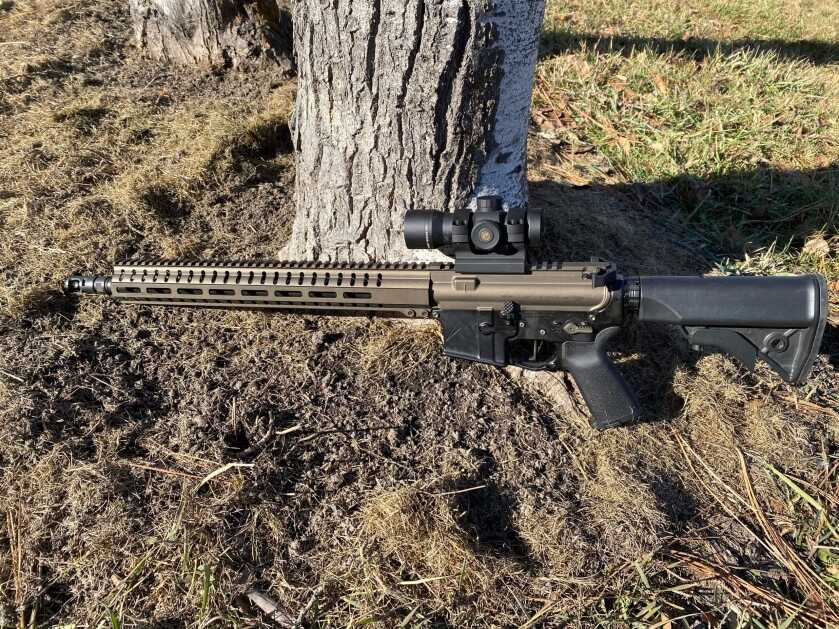
This article originally ran in 2021 as a look at the CMMG Mk57, a 5.7×28 AR-15 upper, paired with the Ruger-57 pistol. The Mk57 we tested had a 16.1 inch barrel, CMMG’s radial delayed blowback system, a skeletonized bolt carrier and an oversized ambidextrous charging handle, and fed from 40 round magazines. The Ruger-57 has a 4.94 inch barrel and a 20 round magazine.
The idea still holds. A 5.7 pistol and a 5.7 carbine share ammunition, and the carbine’s longer barrel adds roughly 300 fps over a 5 inch pistol rating. Our tester also found the guns easy to shoot and accurate, and in a rapid-fire demonstration at the Fest, a Tisas PX-5.7 went through 500 rounds of mixed brands in under seven minutes with zero failures to feed or eject. Our original Ruger-57 review and FN Five-seveN review cover the pistols that started the trend. Today you can build that pairing many ways, from the PSA 5.7 Rock or SDS PX-5.7 to the KelTec P50 and the Ruger LC Carbine.
What the 5.7×28 Can and Cannot Do
What it does well:
- Very light recoil, so fast, accurate follow-up shots.
- High capacity in a compact package.
- Flat trajectory for a pistol cartridge, especially from longer barrels.
- More energy than .22 WMR or .380 ACP by maker ratings.
Where it falls short:
- Ammo costs more than 9mm and selection is narrower.
- High pressure and bullet design mean suppressed guns often show first round pop and occasional hiccups.
- Cases are lacquered, and reloading 5.7 is generally not recommended.
- Even from a 16 inch barrel, it does not approach rifle cartridge velocity or energy.
- Independent, protocol-level defensive testing is still limited, so claims about stopping power should be treated with caution.
5.7×28 Ballistics FAQ
How fast is 5.7×28 from a pistol?
Ammo makers rate typical 40 grain defensive loads at about 1,800 fps from a 5 inch barrel. Speer rates its Gold Dot at 1,800 fps and Hornady rates Critical Defense at 1,810 fps.
How much velocity does a carbine add to 5.7×28?
In our testing, a 16 inch Ruger LC Carbine produced about 2,100 fps, and a 9.6 inch KelTec KP50 produced slightly above 2,000 fps. That is about 200 to 300 fps over typical 5 inch pistol ratings.
How much does 5.7×28 penetrate?
In our 5.7 Fest testing, defensive loads from pistols penetrated 12 to 14 inches of bare clear gel and about 6 to 7 inches into torso gel after passing through quarter-inch plexiglass. Expansion was not measured.
Is 5.7×28 good for self-defense?
Our testing showed adequate bare gel penetration and far more energy than .22 WMR or .380 ACP by maker ratings, with very light recoil and high capacity. Our tester did not consider it superior to 9mm. Choose a load with published, independent testing and practice with it.
Is 5.7×28 more powerful than 9mm?
It is faster, but it uses a much lighter, smaller-diameter bullet. We have not measured 9mm and 5.7 side by side, so we do not claim either is more effective.
Can you reload 5.7×28?
It is generally not recommended. Factory cases are lacquered, and the high pressure leaves little room for error.

Clay Martin is a retired Marine and Green Beret, having served with distinction in the 3rd Special Forces Group. A multi-service, multi-decade sniper, he’s also a seasoned 3-Gun competitor and a Master-ranked shooter in USPSA Production. When he’s not writing about firearms and tactics, Clay is the author of the novel Last Son of The War God, a gritty story about dispensing justice the hard way. Follow him on Twitter @offthe_res or visit his website at Off-The-Reservation.com.
Experience:
– U.S. Marine Corps Infantry, Scout/Sniper, and Recon Marine
– U.S. Army Green Beret, 3rd Special Forces Group (ODA Comms SGT, Intel SGT, SFAUC Instructor)
– Competitive Shooter – Master-ranked in USPSA Production, experienced 3-Gun competitor
– Tactical Instructor – Extensive background in teaching carbine, pistol, CQB, and survival skills
– Author – Fiction and non-fiction works on warfare, survival, and American resilience
– 2A Advocate – Defender of the Constitution and vocal proponent of gun rights
– Outdoorsman – Idaho-based hunter, adventurer, and father of feral children and dogs
I always find Clay’s insight interesting. This may be an idea who’s time may come – someday. But in a long term survival or SHTF scenario, the ability to restock at sometime should be a consideration as well as barter. Even during this time of shortage I come across 5.56 and 7.62×39 quite often. Just a quick look on Ammoseek shows the 5.7×28 is available at over $2.50 each (plus shipping) at the bottom end. 5.56 is going for .83+ cents per round (plus shipping) and 7.62×39 at .38 cents per round, and we know these are current prices way up from a few months ago. Even .308 can be had for around .80 cents for the Russian stuff. Trying to replenish these, or use them for barter in a SHTF scenario will give a person a lot more flexibility and availability. You might be able to carry more 5.7×28 and you’ll probably have a lot less weight in your wallet to drag you down. Someday it might be a reasonable scenario, and perhaps in a sort term survival situation it might be now. But once one is in a survival situation, how can you know it will be short term?
Price vs 22 mag? performance (civilian) vs 22 mag? The next question is when you say survival in what condition and against whom? Are we talking post apocalyptic, behind enemy lines. BLM or on a hike? Personally I think the Israelis have it right. suppressed 10/22 ruger, lol!
Thank you for the article and demonstration pertaining to the 5.7 upper conversion. Did you have to make any modifications to the lower, or was it basically “plug and play” with the appropriate magazine for 5.7?
Clay, I have enjoyed reading your articles for a long time. And…I really appreciate your service to our Liberty!
I’m not trying to be an ass but as we all know now days “words matter” 🤦♂️
Now, since you hit this misuse of the term theory square on the head…
“Now I say theory…”
A theory in science is an explanation of a process that is “known”, is scientifically settled, it’s been figured out already.
The proper term for a process that is not figured out but has a proposed explanation or several concepts that attempt to explain how the process works, is “hypothesis”.
So, in context, we should read “…terminal ballistics hypothesis”. “Now I say hypothesis…”
Now on with the great discussion of the 5.7.
You need to reread the definition of ‘Theory”.
Ammo was hard to find and expensive at the best of times. Maybe if more companies made it.
Hornady…are you listening?
A friend recently bought a Ruger 5.7 and was thrown into catatonic arrest when he discovered how difficult it was to find 5.7 ammo. There was a time when I was keen on picking up an FN 5.7 but I have since cooled my jets concerning such. Ballistically, there is not such a wide gap between the 5.7 and the .22 WRM that I would put myself through such distress.
TISSUE DAMAGE in deer:
.270 velocity bloodshot – 10-12 inches in all directions around the bullet hole. Bloodshot meat must be handled separately from the rest of the deer.
.45-70 – very little bloodshot, maybe 3 inches unless a bone is hit. The old-timers say you eat everything but the hole.
I’ve butchered deer so badly bloodshot by bullet velocity that the shock of the velocity alone was probably enough to kill the animal.
KUDOS on the velocity comments. I don’t know how anyone who has cleaned/examined big game animals taken with traditional high velocity cartridges, could question the absolute increase in lethality caused by cavitation (temporary wound cavity, hydrostatic effect… whatever term you prefer). I’ve taken whitetail deer with .22 LR,. 30-30, .30-06, .280, 7mm RM, .35 Whelen, and .54 patched round-ball. I’ve seen huge sections of the lung cavity turned to jelly by the high velocity rounds. I’ve also seen numerous exit wounds I could put my fist in. I’m neither a Ph. D., nor an MD., but I can conclusively state, VELOCITY MATTERS, and significantly increases the lethality of any round.
Sorry, but there is no REAL evidence of your claim, and plenty off ‘Professional’ hunters and Guides have and do counter your claim.
And when one considers the taking of so many Elephants ( and many other game species) by W.D.M. Bell with a 7 x 57 using solids, your claim falls on it’s face.
Your further claim of “I can conclusively state” in the matter is arrogant at best.
Peter Capstick wrote of this in “Death in the Silent Places”, and discusses several other P.H.’s sharing that opinion.
With regard to my apparent “arrogance”, my rather extensive law enforcement training, including research conducted by the FBI, reinforces my take on the matter. Nowhere in my comments did I state that velocity was the “only way” to effect a kill. If you would have paid attention, you would have read that I’ve taken big game with a .22 LR, a .30-30 Win. and .44 Rem. Mag… none of which are considered “high velocity” rounds vy today’s standards.
Perhaps you are one who subscribes to the theory of “knock down power”, which was completely debunked by FBI research. When dealing with a deadly force encounter, the quickest way to incapacitate someone (absent a brain or spinal cord shot) is to create as large of a wound channel as possible. If you lack observational experience in game animals body-shot with high velocity cartridges, perhaps you can talk to a coroner or Armed Services surgeon about the effect high velocity rounds have on a human torso.
You, sir can shoot whatever floats your boat. You can hurl large rocks with super-slow velocities at your chosen quarry. You will never however, be able to disprove the simple physics of all other things being equal, a higher velocity projectile creates a larger wound channel.
BTW, Karamojo Bell made brain shots with his mauser. Capstick did the same thing with his .470 Nitro Express when dealing with elephants.
If deer size game is headshot with a .22 mag then “Bloodshot” is not much of a problem. You can eat the whole deer. I know 22 WMR is not a legal hunting caliber in some areas but it drops game like a rock if properly applied to the cranium. You don’t need a cannon for hunting if you can shoot.
Compatibility of long gun and pistol magazines is a priority to many when trying to go down this road. I know of someone who had the FN pistol and bought the AR Banshee CMMG 5.7 The rifle was “not so great” and was sold in a few months. The 22TCM I think WOULD be a better choice but for the limited availability of different manufactured ammo. The OAL is better (shorter) than the 5.7 Although there are some Glock conversions for it, they require the use of the 22TCM 9R round. (dumb) they should have just made a conversion for the larger Glock 10mm or 45 pistols that would have worked perfectly with the standard 22TCM not the 9R variant. IMO the best firearm for this round currently would be the PS90. 16 inch barrel and 50 round magazine standard, very compact. Good article now back to packaging machine guns for undocumented persons and cartels.
Positive and a negative-
I’ve dropped a whitetail deer with one shot from the ps90.
Negative. When competing and shooting steel plates the small 27 grain round won’t push over some steel plates like a round with more lead. But the fiveSeven pistol is so easy to shoot that I was able to triple tap to push over the steel plate.
I can make solid 25 yard head shots and 50 yard body shots with the pistol. My wife prefers to shot the FiveSeven over my 9mm glock or mp2.0.
Look at all the BS in these comments. Most amusing. The SS190 is in fact it was designed to yaw well at pistol or SBR velocities, VS the SS109 which is as stated above a flying ice-pick. On Availability, I can still get 5.7 ammo today, $2/round. Hard to find 5.56 or 9mm at all, and if you do it is well over 1$ / round, and frequently $2/round. There goes that idea LOL. Nidal Hassan was taking center-of-mass shots on the majority of his victims, and head-shots only when close according to survivors. But as far as head shot potential, after running about 600 students in our defensive pistol training classes in 2019 where we had all of them try the FN Five-seveN, 98.2% increased their head-shot successes by at least 50%, and 100% had some increase. So the fact the ammo allows a greater potential for a head shot should not be viewed as a negative IMO.
The velocities he used are off the shelf Fed American Eagle 40gr, or FN 40gr blue tip. Move up to real ammo like Elite Ammunition S4M, you get about 2600 FPS from the pistol, and 3100 FPS from the 10.5″ carbine. Plus Speer now makes Gold Dot for the 5.7x28mm. My only beef – and I sell a lot of guns in my shop – is the return rate on the Ruger 57s. Lots of magazine issues, lots of FTF and FTE – all in all if I carry the 5.7 round, it is in my tested and reliable FN Five-seveN MKII. The CMMGs are fantastic in my 10.5″ SBR and would be in the AR pistol too.
Nice article – keep up the great work! For those wondering – availability of ammo is not a consideration for me – I have at least 15k rounds in every caliber I own (which I have pared down over the past 5 years to 9) and there is just no way I would run out of ammo in a WROL situation for over a decade. By then good luck finding ANY caliber unless you roll your own – and as we are seeing now – only if you have been stockpiling components, primers, powders, and projectiles for years. It is something that needs to be planned for and acquired over a number of years. In the current state of politics and insanity – you may not be getting much more of whatever you shoot for quite a while more from now. But let us hope not.
From reading the 5.7×28 was designed for the military to defeat Chinese body armor as a sidearm/sub gun caliber.
The 5.7 out of an AR pistol does perk my interst the cost of the P90 and ammo was always a big downer. This is like the modern version of having a 357mag hand gun and lever action. Always love your articles and vid keep up the good work!
Another interesting article with lots of good information to ponder. That’s why I love reading Clay Martin’s reviews. I can’t afford to re-tool, as they say, no matter what the cost. I have too much invested in my current setup. My setup works for me. But… The information lends itself to new choices, and new debates. That’s a good thing for everyone. Research, research, research. Gain as much knowledge as you can from reliable sources. Then make your decision from all of that and gain as much experience as possible from that decision.
Thanks Clay, for another enjoyable article.
@BG Ferguson… Regarding your concern as to what’s behind the target being a safety issue… After putting the photos in some computer software and using the angle of the barrel, and judging from the angle at the top of the rise, the path of the bullet will strike the ground well before the rise at the top of the hill. Plus… We cannot see beyond the right side of the photos to what’s actually directly behind the target. Judging by Clay’s background. There could be an M1 Abrams MBT set up for his next review. Safety is very important, so, along with pointing that out, there was much more to his article worth commenting on as well.
Sigh – 5.7 pimping…
I still have my FN57 – purchased right after the Fort Hood incident. Purchased mainly for capacity, and it’s obvious demonstrated ability to maim & kill. Probably have about 1,000 rounds of original FN boxed ammo for it also – even some of the LEO Only SS190 stuff.
That being said – survival requires you to be able to RE-ARM, usually from the ammo of “vanquished foes”, and we’re not going to find very many of those, SHTF, out in the Mad Max world we are rapidly creating.
I was drooling over the Ruger 5.7 – top of my list – until a friend got one, and I found it didn’t really fit my paw well. Not that mind carrying a full sized pistol (current carry is a Kimber Pro Carry II in GODS CALIBER – .45 – when you KNOW HOW TO SHOOT – you don’t need 21 rounds). OFF the list.
The CMMG upper is interesting though. Don’t know that I’d get one in 5.7. I’m really liking the Sig piston uppers with integral bolt/recoil systems. NO BUFFER TUBE REQUIRED – which makes for a much more compact weapon system with a folding/collapsible that you can fire closed.
Then again – I also have a Tavor SAR & T-7 – loving bullpups lately for CQB/urban/house clearing.
Good ballistics writeup though. But again – as others mentioned – cost/availability, especially in “survival mode”, don’t really make this a logical choice for load-outs. 5.56 & 9mm are going to be the rounds “most available” in the field, and also good for barter should things continue to go sideways. Wish I had more 5.56 – but I have plenty of 7.62×39 & 51, 9mm & .45.
Always interested when I see a 5.7 article. No doubt one of the more interesting of the “weird calibers”. Not enough to make me get more of them though.
Rick
At CMMG, the AR conversion seems to be on par with a high quality AR upper. However, the ammo… At $2/rnd, I’ll pass for now. Maybe things will return to rationality sometime soon.
Nidal Hassan was shooting those FT Hood soldiers and was trying to take head shots on all of them to ensure the hits were fatal.
Also the SS109 Bullet was designed to not yawl so as to penetrate Soviet body armor. The result was the 109 was a flying ice pick that tended to wound more that kill as compared to the older ammo. Th newer army ammo was designed for penetration a yawl when hitting flesh.
BTW at what range does the 5.7 ammo drop below the speed needed for the hydrostatic effect and at what range does the bullet fall below the speed needed to fragment when fired from a rifle? Most places in the eastern US a 100 meter shot would be a long one but could expect to kill or wound the target.
Although concurrent with the authors data points, the matter of 5.7 price has always been an issue long before the ammo panic. I have owned both FN platforms yet decided to sell due to ammo cost reasoning. A mistake or not, second guessing that decision can be in the cards however if one is going to pic a survival cartridge or a catch all, the 5.7 IMHO is not my choice do to the uncommonality.. I don’t downplay the extreme fun and appreciation for the 5.7 but it all rolls into availability and cost for most… great article to get the juices flowing….
The photos of your shooting range show the slight ridge in the background and the land falling away beyond your vision. Shouldn’t you have a backstop that rises up and not falling away? How do you know if there is or isn’t a person, vehicle or someone’s dog just beyond the rise and in the path of your bullets?
Great caliber but did you saw it in stores? Or even if in stores what was last price on it?
I have been pondering this exact same thing. Is the cost of two new plat forms worth it?